

MEET BIRELI LAGRENE

Since the 1980s, Bireli Lagrene has reigned as one of the world's undisputed masters of jazz guitar.
In the early 1980s, Lagrene emerged as a child prodigy - a true “wunderkind” - transforming raw talent into profound artistry. Born in 1966 in Saverne, in France's Alsace region (the heart of the Gypsy community), he grew up in a family of musicians. His father and brother introduced him to the guitar at an early age, and he was soon spotted by Matelot Ferré, a close companion of Django Reinhardt.
Heavily influenced by Django in his formative years, Lagrene immersed himself in the master's recordings, first recreating choruses verbatim before forging his own distinctive voice. This evolution shines through in his early trilogy: Routes to Django (1980), Bireli Swing '81 (1981) and Fifteen (1982) - a bold "free manifesto" echoing the Manouche spirit of unbound liberty. As Lagrene has said, "Django helped me go and see what is happening elsewhere," with jazz representing limitless freedom.
Bireli was influenced not only by Django, but also Wes Montgomery and George Benson and soon turned to the fusion of Jaco Pastorius and Weather Report.
From 1986 onward, following collaborations with Stéphane Grappelli and Larry Coryell, Lagrene dove fully into fusion. He briefly considered the bass (inspired by Pastorius, he proved a formidable player) but ultimately recommitted to guitar, developing a dazzling, highly adaptive style marked by exceptional improvisation. This period brought collaborations with legends like John McLaughlin, Paco de Lucía, Al Di Meola, Jack Bruce and Ginger Baker (in a temporary Cream reformation), Stanley Clarke, Miroslav Vitouš, Lenny White, and Mike Stern. Not to mention two live albums with Jaco Pastorius himself.
In 1990, Acoustic Moments offered a stunning synthesis of traditional jazz and fusion. He found further critical acclaim with the "classic" approach of Standards (1992). The 1993 release Viaggio marked rising national and international recognition, including the prestigious Django d'Or award that year. In 2001, he earned a Victoires de la Musique (France's equivalent of a Grammy) for Front Page (2000), a power trio project with Dominique Di Piazza and Dennis Chambers for Universal. This success fueled the acclaimed Gipsy Project (2001).
At 35, after exploring nearly every facet of modern guitar and collaborating with the finest jazz musicians, Lagrene - wild yet subtle, lightning-fast - returned boldly to his roots. He balanced virtuosity and depth in Gipsy Project & Friends (2002), celebrating tradition with joyful spontaneity.
Continuing in the tradition of Gypsy jazz, Move (2004) was refreshingly innovative by replacing violin with saxophone, delivering a striking repertoire and masterful swing. Growing success led to major festival tours and a triumphant 2005 Olympia recording featuring guest guitarist, the late Sylvain Luc.
In October 2006, celebrating his 40th birthday, Dreyfus Jazz released the exceptional double CD set Djangology (with the WDR Big Band Cologne) and To Bi or Not To Bi (a solo live album).
The album Mouvements (2012, Universal) showcased another facet of his versatility: A sophisticated fusion blend of blues, jazz, groove, and rock-tinged elements. Recorded with a modern quartet featuring several original compositions alongside standards highlighting Lagrene's instrumental command and ability to bridge neoclassical, swing, ballads, and blues in a cohesive, groove-driven sound.
The past 26 years - honored by the 2012 Chevalier des Arts et des Lettres medal have seen Lagrene released 19 albums, including The Alternative (with Jimmy Rosenberg and Angelo Debarre), the inspired D-Stringz (with Stanley Clarke and Jean-Luc Ponty), the magnificent Tribute to Stéphane & Django (with Roby Lakatos), Remembering Jaco(with The Multiquarium Big Band), and the superb solo recording, Solo Suites (2022).
In 2026, Elegant People reveals Lagrene in pursuit of the essential. With his instrumental mastery at its peak, he sheds unnecessary acrobatics for fundamentally spontaneous expression guided by clear vision. Meticulously prepared with carefully selected pieces and original compositions, the recording offers his new quartet contrasting landscapes ideally suited to a true group sound. More information on Bireli’s new album and tour dates here: https://birelilagrene.com/touring/
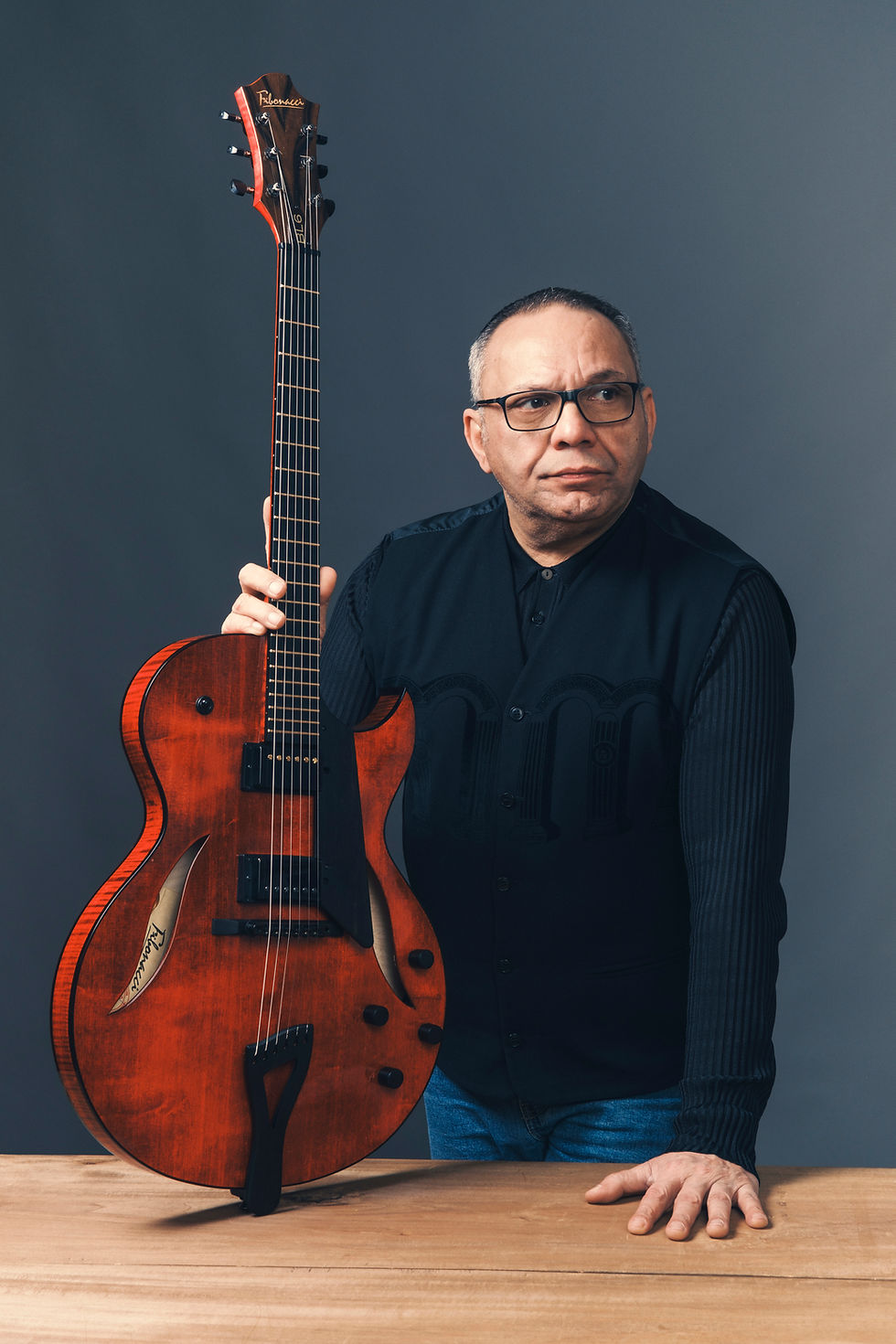
The Fibonacci BL6, is the stunning carved archtop designed in collaboration with the legendary guitarist. It is a fully hollow archtop guitar featuring a carved, hand-graduated spruce top and carved flame maple back and sides, sourced from slow-grown tonewoods in the Carpathian Mountains. With a slim 44mm (1.74”) body depth, a 400mm (15.75”) lower bout width, and a florentine cut-away, the BL6 ensures easy access to the upper frets, catering to Lagrene’s dynamic playing style. The guitar boasts a one-piece flame maple neck with a soft ‘D’ shape, a flat radius ebony fingerboard, a 43mm (1.69”) bone nut, a 635mm (25”) scale length, and 22 Jescar EVO gold frets. Equipped with a pair of handwound Kloppman humbuckers 7.8k output at the neck, 8.8k output at the bridge, the BL6 offers a robust electrical configuration. It includes 2 volume and 2 tone CTS 500k audio sweep pots, Spraug 0.22 & 0.33 caps, a 3-way Switchcraft switch, and a mono Switchcraft output jack, all wired with heat-shrink steel-graded wiring. Finished in deep cherry nitrocellulose lacquer with ebony binding, the BL6 is as visually striking as it is sonically versatile, delivering a lightweight, resonant tone unplugged and dynamic performance when amplified.
“Bireli’s vision was clear: a guitar that could move effortlessly between genres while maintaining the soul of traditional craftsmanship,” said Graham Esson, Director at Fibonacci Guitars. “The BL6 is a testament to his artistry and our commitment to creating instruments that inspire.”
The Fibonacci BL6 is available for order. For more information about the BL6 or Fibonacci Guitars, please visit www.fibonacciguitars.com/BL6


Comments