

Why Handmade Archtop Guitars Matter

Why Handmade Archtop Guitars Matter
A fine archtop tells on itself within seconds. You hear it in the first chord, certainly, but you feel it even sooner - in the resistance under the pick, the way the note leaves the string, and the balance between attack and bloom. That is why handmade archtop guitars continue to hold such authority among serious players. They are not simply expensive versions of factory instruments. They are different in conception, in execution, and in the standard of judgement applied at every stage.
For the player who already knows what a carved top, a responsive body and a properly voiced instrument can do, the distinction is obvious. For the buyer moving up from production models, the question is usually more practical: what, precisely, are you paying for? The honest answer is time, judgement, and control - three things scaled manufacturing cannot offer in the same way.
What sets handmade archtop guitars apart
The defining difference is not romance. It is decision-making. In a workshop environment, the builder can respond to the specific piece of timber on the bench rather than forcing it through a fixed industrial process. Two spruce tops may share a species, but they do not share identical density, stiffness or tap response. The same is true of maple backs and sides, neck blanks and fingerboards. A handmade instrument allows those variables to be assessed and worked with, not averaged out.
That matters because an archtop is unusually sensitive to small changes. Arching height, plate graduation, bracing profile, neck angle and bridge geometry all affect how the guitar speaks. A millimetre here or there can alter projection, warmth, headroom and note separation. On a factory line, consistency is achieved by standardising these decisions. In a specialist workshop, consistency is achieved by making the right decision for each instrument.
There is also the question of restraint. A genuinely high-end archtop does not need to be overbuilt to survive production handling, warehousing and global volume distribution. It can be built to perform. That distinction often produces a livelier top, a more immediate response and a more sophisticated dynamic range.
The build process behind a serious archtop
A handmade archtop begins long before assembly. Timber selection is foundational, not decorative. A visually striking maple set means little if it lacks the structural and acoustic properties required for a responsive back and sides. Likewise, a soundboard must be chosen for more than appearance. Grain, stiffness, weight and seasoning all influence the finished result.
Once selected, the wood must be worked with sensitivity. Carving a top and back is not merely a shaping exercise. It is the process of tuning mass and flexibility so the body behaves as a coherent acoustic system. Remove too much material and the instrument may become unstable or overly sharp in its response. Leave too much and the guitar can feel constricted, with reduced complexity and air.
Neck construction and fitting deserve equal attention. On a premium archtop, the neck should feel composed and exact, with geometry that supports low, clean action without sacrificing tonal energy. A poor neck set can make even attractive instruments feel compromised. A precise one allows the bridge, top and strings to work together properly.
Finishing is another area where workshop standards reveal themselves. Thick, hurried finishes can inhibit resonance and obscure the tactile quality of the wood beneath. By contrast, carefully applied nitrocellulose lacquer or oil finishing preserves character while allowing the instrument to breathe and mature. It is not only an aesthetic choice. It is part of the guitar's performance.
Why handmade archtop guitars sound different
The tonal character of an archtop is shaped by more than pickups or hardware. The acoustic voice of the instrument remains the core. Even on an amplified model, the way the body reacts to the string governs articulation, sustain profile and the subtle compression the player feels under the hand.
A strong handmade archtop typically offers clearer note separation, particularly in extended chords and complex voicings. The low end is more disciplined, the midrange more informative, and the treble less brittle. That does not mean every handmade instrument is bright, dark, loud or mellow. It means its voice tends to be more intentional.
This is where factory comparisons can become misleading. A production guitar may impress in a quick shop test with a flattering setup or a voiced pickup. Over time, serious players usually listen for deeper qualities: whether single notes stay coherent higher up the neck, whether chords collapse under heavier attack, whether the top has headroom, and whether the guitar retains musical detail at lower volumes. Handmade instruments, when properly built, tend to answer those demands more convincingly.
Materials, hardware and the cost of compromise
At the premium end of the market, materials and components are not interchangeable details. They are part of a controlled system. Hand-selected UK and European tonewoods, carefully matched hardware, quality fretwire, stable truss rod design and accurately cut nuts all influence reliability as much as tone.
This is one reason discerning buyers grow wary of vague specifications. If a maker cannot tell you where the principal materials come from, how the top is built, what finish is used, or how the instrument is tested, confidence becomes difficult. Prestige without transparency is merely presentation.
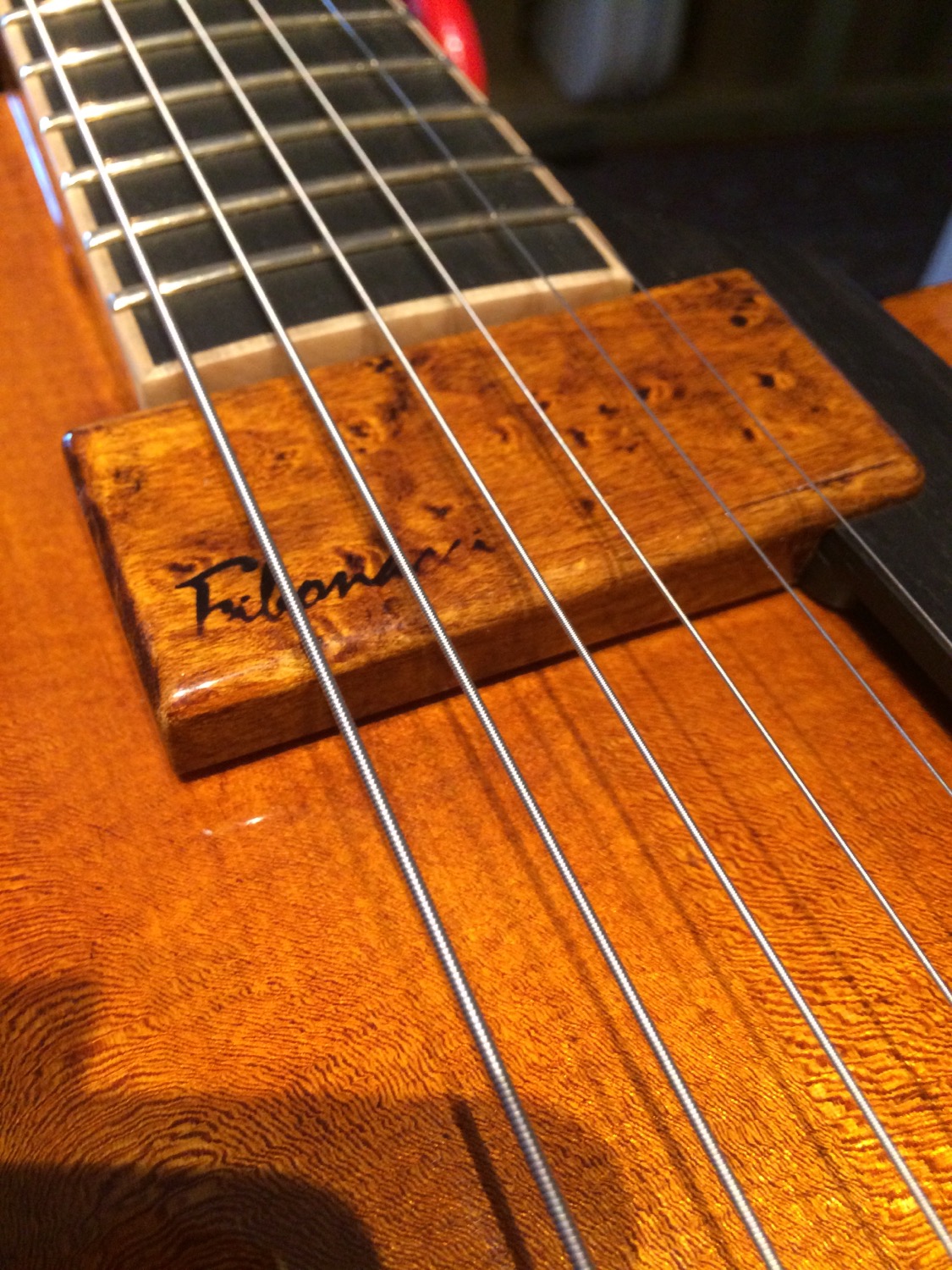
The same applies to electronics. A floating humbucker, a mounted pickup, control placement and wiring quality each bring trade-offs. A floating pickup can preserve more of the top's acoustic behaviour, while a mounted option may offer a different amplified character and user preference. There is no universal best choice. There is only the right choice for the design brief and the player.
Who benefits most from a handmade archtop
Not every guitarist needs one. That is worth stating plainly. If your priorities are maximum durability for casual use, low initial outlay, or a general-purpose instrument for occasional jazz standards, a good production model may be entirely sensible.
Handmade archtop guitars come into their own when the player can hear and feel the difference, and when the instrument will be used enough to justify its depth of capability. Professional musicians appreciate consistency under microphones, in studios and on stage. Experienced players value touch sensitivity and tonal nuance. Collectors and connoisseurs look for authenticity of build, rarity and long-term integrity. In all three cases, the appeal is not novelty. It is confidence.
That confidence extends to ownership. A boutique instrument should arrive with clear provenance, careful inspection, proper documentation and meaningful aftercare. For a buyer at this level, assurance matters almost as much as aesthetics. A refined instrument deserves support that matches its standard.
Choosing among handmade archtop guitars
The right instrument depends on your ear, your repertoire and your expectations. A player focused on traditional jazz comping may prioritise warmth, dryness and strong fundamental note content. Someone working across jazz, soul and contemporary session work may want broader frequency response and more sustain. Neck profile, scale length, body depth and pickup configuration all shape the experience.
Price differences within handmade ranges can also reflect very real distinctions. More exclusive models may involve rarer timber, more labour-intensive carving, upgraded appointments, signature specifications or a greater level of individual finishing detail. That does not automatically make the top-tier instrument the correct one for every buyer. It means the purchaser should understand what those differences are and whether they matter in practice.
For that reason, serious makers develop instruments through real playing conditions, not theory alone. Workshop judgement must be tested against the demands of recording, amplification and sustained professional use. It is one thing for an archtop to look impressive on a stand. It is another for it to remain articulate, balanced and inspiring across years of work. That is where a boutique manufacturer such as Fibonacci Guitars earns its place.
A handmade archtop is best understood not as a luxury add-on, but as an instrument built without the usual concessions. If you value that level of control, material honesty and tonal refinement, you are not buying into mystique. You are choosing a guitar with fewer excuses built into it - and that tends to reward serious hands for a very long time.


Comments