

Do Carved Guitars Sound Better?
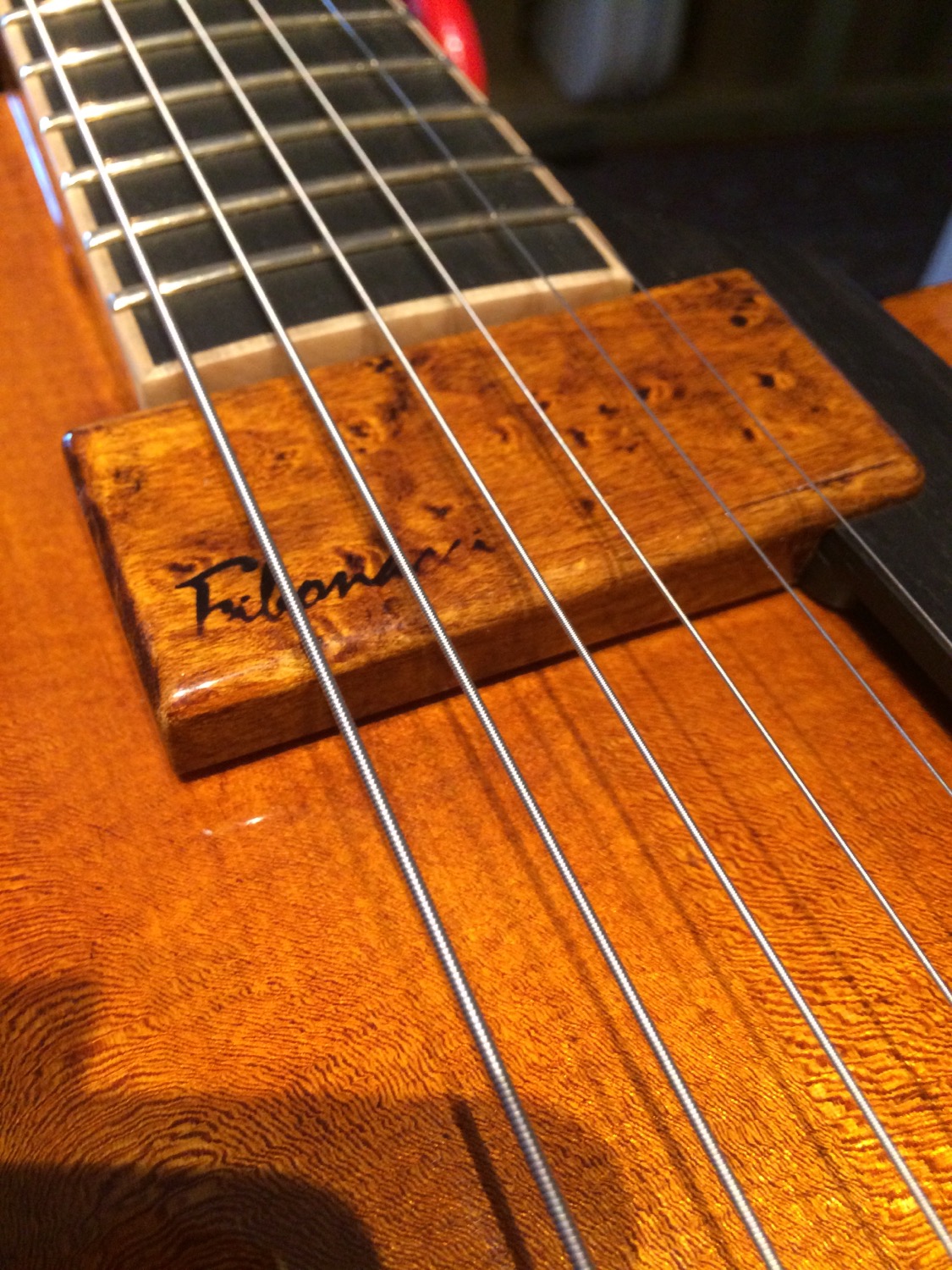

Play one open chord on a finely made archtop and the answer to ‘do carved guitars sound better’ will feel obvious. The note seems to bloom faster, the midrange carries more shape, the bottom end is more dynamic, and the instrument responds with a kind of ease that players notice immediately. But serious players know instinct is only the beginning. The more useful question is better for what, and under which hands.
For archtops in particular, carving is not a decorative flourish or a marketing phrase. It is a structural and tonal decision that changes how the top and back behave under string energy. When it is executed properly, by a maker who understands graduations, arching, stiffness and tap response, a carved guitar can deliver a level of nuance and dynamic control that pressed construction rarely matches. That does not mean every carved instrument will outperform every laminated or pressed one. It means the ceiling is higher, and the variables matter.
Do carved guitars sound better on an archtop?

On the right instrument, yes - carved guitars almost always sound better in the ways experienced players value most. They tend to offer greater complexity, stronger note separation, a more tactile attack and a wider dynamic range. A good carved archtop does not simply make a guitar louder. It gives the note more character.
That matters because an archtop is not judged on volume alone. It is judged on how it projects, how it compresses or resists compression under the pick, how chords stack, and how single lines hold their shape. A carved soundboard can be tuned through thickness and arch to encourage exactly those qualities. Instead of forcing uniformity, the luthier can work towards a responsive acoustic system.
Pressed tops, by contrast, are typically built for consistency, efficiency and durability in production. They can be excellent in their own right, particularly for amplified use, but they are less individually voiced. Their strength is repeatability. The strength of carving is refinement.
Why carving changes the sound

A carved top is shaped from solid wood, usually spruce for the soundboard, and graduated to different thicknesses across its surface. The back is often carved from maple. This allows the maker to control stiffness and flexibility in specific areas rather than relying on a fixed sheet formed into shape.
That difference is fundamental. Wood is never perfectly uniform. Grain width, density and elasticity vary from one billet to the next. In a carved build, those natural differences can be read and answered during the making process. A slightly stiffer top can be taken to a different graduation. A more elastic piece may require a different final thickness. The result is not just a carved guitar, but a voiced one.
This is where better can become meaningful. Better response often comes from a top that releases energy quickly without sounding thin. Better projection comes from efficient movement across the plate. Better articulation comes from the top and back working together rather than fighting each other. None of that happens by accident.
The role of arching and graduation

Arching determines more than appearance. The shape of the arch affects stiffness, load distribution and how the plate flexes. Graduation determines how the plate responds to vibration across its centre and flanks. Together, they control the voice of the instrument.
A well-carved archtop can therefore be built with remarkable precision of intent. It may be voiced for clean jazz comping with fast note decay and excellent focus. It may be balanced towards a more open, singing response for melodic players. The key point is that carving gives the maker far more tonal authority than a process built around pressing components into broadly standard forms.
Where carved guitars tend to excel

The first advantage most players notice is immediacy. Pick lightly and the instrument speaks. Lean in and it does not collapse into bluntness. That headroom is one of the great attractions of aproper carved archtop.
The second is harmonic detail. Chords often sound more dimensional, with the inner notes retaining identity rather than merging into a single block. On single-note lines, the attack tends to feel more connected to the hand. There is often a dry, articulate edge around the note, followed by a richer body of sound.
The third is acoustic authority. Even players who use a floating pickup or perform mainly amplified often value the acoustic behaviour of the guitar because it affects touch, sustain and phrasing. A guitar that is alive in the hands tends to inspire different playing.
For collectors and advanced players, there is also the matter of individuality. Because carved instruments respond directly to the wood and the maker's judgement, they often possess a more distinct personality. Two excellent carved archtops may share a family resemblance, but they will not be identical in the way large-scale production tends to encourage.
When the answer is no

If the question is do carved guitars sound better in every context, the honest answer is no. Better depends on the application.
A laminated archtop can be the stronger working tool for loud amplified settings where feedback resistance matters more than acoustic sophistication. Some players want a tighter, more controlled platform that stays stable under high stage volume and delivers a familiar electric voice. In that environment, the advantages of carving may be partly masked or simply less relevant.
There is also the matter of execution. A poorly carved guitar is not redeemed by the word carved. If the arching is clumsy, the graduations are indifferent, or the wood selection is unremarkable, the result may be underpowered, uneven or overly delicate. A superbly made pressed or laminated instrument will easily outclass a mediocre carved one.
This is why serious buyers should be wary of simple binaries. Construction method matters, but craftsmanship matters more.
Do carved guitars sound better than laminated ones for jazz?

For acoustic richness, touch sensitivity and tonal depth, they almost always do. For sheer practicality in certain band settings, laminated instruments may still be the right choice.
Traditional jazz players often favour carved archtops because of the dry attack, focused projection and sophisticated midrange these instruments can deliver. There is a reason the finest historical archtops were carved by hand and continue to set the standard. They reward a developed right hand and reveal subtle differences in articulation that flatter advanced technique.
Yet not every jazz guitarist wants maximum acoustic complexity. Some want a more contained amplified sound, a faster decay, or an instrument they can push hard on stage without compromise. That is not lesser judgement. It is simply a different priority.
What serious buyers should listen for

When assessing a carved archtop, listen beyond first impressions of warmth or volume. The more revealing questions concern control.
Does the guitar maintain clarity when you voice dense chords in the middle register? Does the note stay coherent when you move from a soft touch to a firm attack? Is the bass supportive without becoming woolly? Does the treble carry substance rather than just brightness?
You should also listen for balance across the neck. A distinguished carved instrument feels integrated. The low register,mids and upper positions belong to the same musical voice. If one area jumps out awkwardly, the build may be chasing effect rather than refinement.
Physical feel matters as well. A well-made carved archtop often has a certain elasticity under the pick. It does not merely produce sound - it returns information to the player. That feedback loop is part of what separates an expensive instrument from a truly exceptional one.
Better materials are not enough

Premium spruce, fine maple, nitrocellulose lacquer, careful setup - all of these matter. None of them guarantees tonal superiority on their own. The advantage of carving only appears when the entire build philosophy supports it.
That means disciplined wood selection, patient seasoning, accurate carving, intelligent voicing and final assembly that preserves the instrument's acoustic intent. It also means resisting the compromises of scaled manufacture. The finest carved archtops are not efficient objects. They are labour-intensive, judgement-heavy instruments that ask more of the maker at every stage.
This is precisely why they continue to occupy the highest tier of the market. When a workshop commits to carved construction properly, as Fibonacci Guitars does, it is making a statement about standards, not just specifications.
The real answer

So, do carved guitars sound better? Often, yes - especially if you value dynamic range, tonal complexity, articulation and amore intimate connection between hand and instrument. But carved construction is not magic, and it is not a shortcut to excellence. Its value lies in what an expert maker can do with it.
For the player who listens closely, that difference is rarely theoretical. It is there in the attack of a chord, the shape of a melody note, and the way the instrument seems to breathe with you rather than simply respond. That is the point at which better stops being aslogan and becomes something you can hear, feel and trust over years of playing.


Comments