

What Makes a Carved Archtop Guitar?
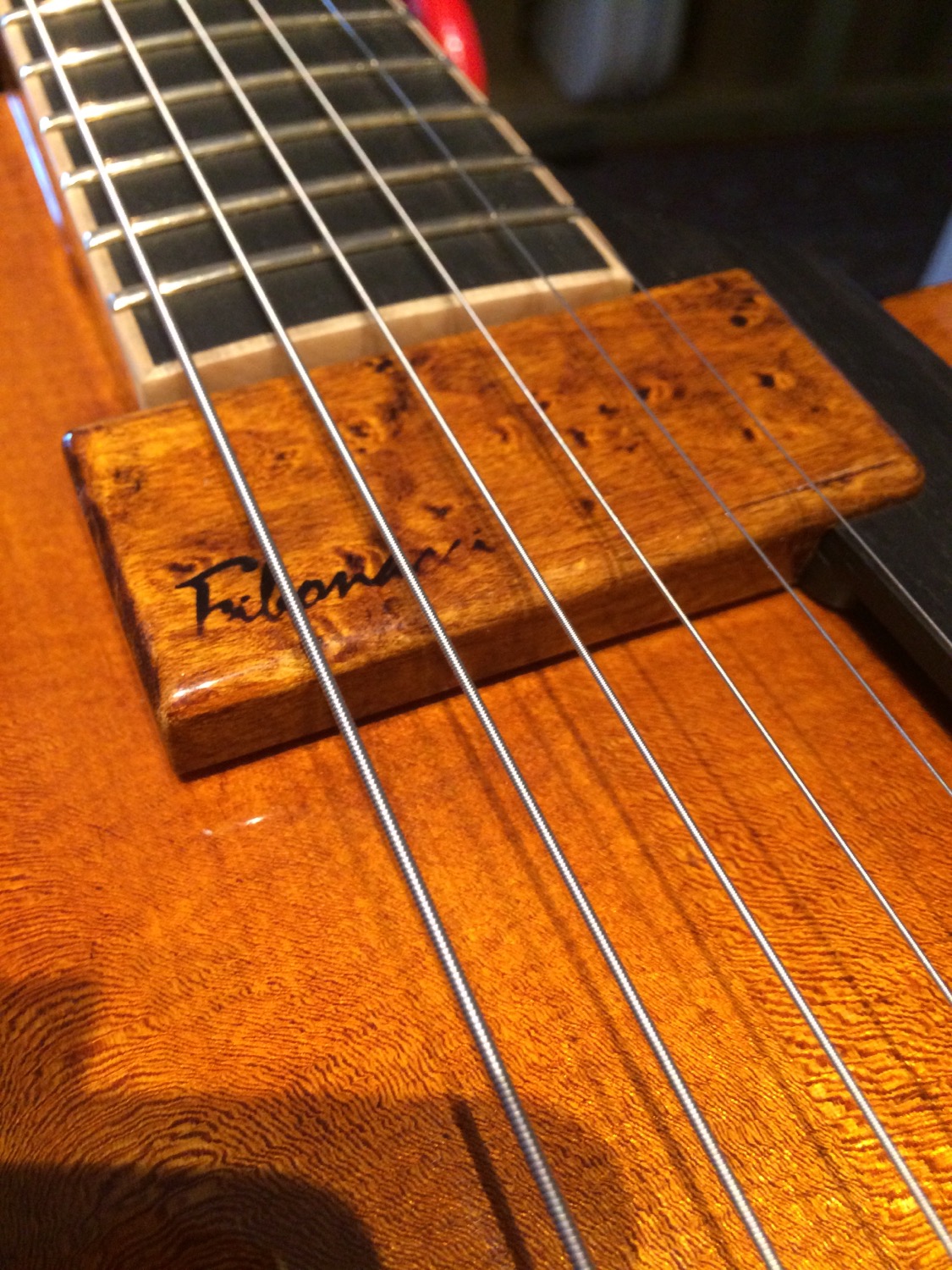

The difference is usually obvious before a note is played. A carved archtop guitar has a certain authority, it feels much lighter and more resonant in the hand and under the plectrum - a quickness of response, a more complex bloom to the note, and a sense that the top and back are working as an acoustic structure rather than simply acting as a shaped surface. For experienced players, that distinction is heard, felt and, over time, deeply preferred.
In the broad archtop market, "arched top" can mean very different things. Some instruments use pressed or laminated construction, which has its own valid place, especially for durability, feedback resistance and cost control. A truly carved instrument belongs to another category. It is built around a soundboard and, often, a back that have been individually graduated and voiced from solid tonewoods, with the arch formed through carving rather than pressing.
Why a carved archtop guitar is different

At the heart of the matter is how it is made. In a carved instrument, the luthier begins with solid wood and shapes the arch by removing material with precision. That process determines not only the external contour but the internal thickness profile across the plate. Those thicknesses are not arbitrary. They influence stiffness, flexibility, projection, attack and the way the guitar supports the fundamental note as well as its harmonic content.
That is why serious players often speak of carved archtops in almost acoustic terms. The top and back are not merely decorative, and it is not simply there to carry hardware. It is an active, responsive diaphragm. A well-made carved plate can produce exceptional clarity while retaining warmth, and it can separate notes cleanly even under complex harmony or a forceful right hand.
This does not mean every carved archtop sounds the same. Far from it. Carving opens the door to nuance, but the outcome depends on wood selection, arching profile, graduation, bracing, scale length, body dimensions and setup. A carved archtop gives the maker more control but it also demands more judgement when being produced.
Carved versus laminated tops

The comparison matters because many players encounter archtops first through laminated instruments. Laminates are not inferior by default. They are often excellent stage tools, particularly when amplified at higher volume. Their relative rigidity and reduced acoustic complexity can help manage feedback, and they have long been used on important professional instruments.
A carved archtop guitar, however, is usually chosen for different reasons. It tends to offer greateracoustic sophistication, more dynamic range and a stronger connection between touch and tone. Pick lightly and the note still speaks. Dig in and the instrument gives more back. That elasticity is one of the defining pleasures of a fine carved archtop.
There are trade-offs. Carved instruments are more labour-intensive, more demanding to build well and typically more expensive. They can also be more revealing. If your technique is uneven, the guitar may not flatter every inconsistency. For the player who values articulation, nuance and a richer acoustic voice, that honesty is part of the appeal.
The role of tonewoods in a carved archtop

Tonewood choice is critical, but it should never be discussed as though one species automatically guarantees one result. The top is commonly made from spruce because spruce combines low weight with high stiffness, allowing the plate to move efficiently while retaining structural integrity. Within that broad category, cut, density, grain quality and seasoning all matter.
The back and sides are often maple, valued for focus, definition and projection. Maple can help keep the voice of the instrument organised, especially when the top is already producing a wide range of overtones. In a carved guitar, this balance between top and back is essential. Too much softness in the wrong places and the instrument can become indistinct. Too much stiffness and it may feel constrained.
This is where boutique craftsmanship justifies itself. Hand-selected tonewood, properly seasoned and evaluated by an experienced eye, gives the maker a far better starting point than anonymousstock processed for scale. A carved instrument rewards that attention because the wood is doing real acoustic work. Its properties are not hidden behind heavy compromise.
Arching, graduation and voicing

When players talk about a guitar being alive,they are usually responding to decisions made in the carve. The arch itselfaffects strength and responsiveness. A higher, fuller arch will behave differently from a flatter one, and neither is automatically better. It depends on the tonal target, the body size and the style of player the instrument is intended for.
Graduation is just as important. The thickness of the top and back is varied across the plate to control how it flexes. Leave too much mass and the voice can become tight or slow. Remove too much and the result may be unstable, overly bright or lacking in headroom. The finest work lies in the judgement between those extremes.
Voicing takes that judgement further. Rather than treating every top to a fixed recipe, the luthier responds to the individual piece of timber. Two spruce sets from the same supplier can behave differently under the tools. One may want a slightly different graduation. Another may favour a subtly altered brace profile. This is one reason low-volume makers can achieve results that factory systems struggle to match. The process depends on close listening, experience and restraint.
How it feels to play

A serious archtop is not judged by specification alone. It is judged by how directly it translates intention. On a strong carved instrument, single-note lines tend to have shape and immediacy. Chords retain separation. The attack can be crisp without becoming harsh, and the decay often carries a beautiful, controlled complexity.
For jazz players, that can mean a fundamental-rich voice with enough air around the note to keep harmony articulate. For chord melody, the best carved tops preserve detail across the register instead of compressing into a single block of sound. For players who cross into acoustic, swing or even more contemporary styles, the wider dynamic range can make the guitar feel less limited and more expressive.
Neck geometry, fretwork and setup still matter enormously, of course. No carved construction can compensate for poor playability. But when the acoustic engine is right, the entire instrument tends to feel more coherent. The player is not fighting for tone. The response isthere from the start.
Build quality matters more than labels

The phrase itself - carved archtop guitar - can be used loosely in the market, so discerning buyers should look beyond headline terminology. Ask whether the top is carved from solid wood, whether the back is also carved, how the instrument is braced, what finish is used, and how much of the build is done by hand rather than outsourced into fragmented production.
This is why provenance and transparency matter at the premium end of the market. A genuinely high-calibre workshop should be able to explain not just what an instrument is made from, but why those decisions were made.
Who should buy a carved top archtop guitar?

Not every player needs one. If your primary requirement is high-volume amplified performance in difficult stage environments, a laminated guitar may be the more practical choice. If budget is the deciding factor, carved construction will naturally move the conversation into a more rarefied bracket.
But for the player who values touch sensitivity, acoustic character and the depth that comes from individually worked timber, a carved instrument is often the correct answer. It suits professionals who want detail in the studio, serious enthusiasts who appreciate fine making, and collectors who understand that true craftsmanship cannot be rushed or standardised.
At that level, the guitar is not merely a tool for producing notes. It is a developed instrument with a distinct voice, shaped by material, method and judgement. Having designed a range of contemporary looking instruments, Fibonacci Guitars build in the tradition of carving their archtops, where every construction choice serves performance first and compromise is kept to an absolute minimum.
The best advice is simple: listen with your hands as much as your ears. A fine carved archtop will tell you very quickly whether it has been built with conviction, and that conversation tends to deepen the longer you own it.


Comments