

How Carved Soundboards Affect Projection

Projection is one of those qualities players recognise instantly but struggle to define precisely. You hear an archtop across the room and it either carries with authority or it seems to stay close to the player. When discussing how carved soundboards affect projection, the answer is not a marketing slogan or a single design trick. It is a matter of structure, stiffness, mass, arching, graduation and, above all, how skillfully those elements are brought into balance.
What projection really means on an archtop
Projection is not simply volume. A guitar can sound loud to the player yet fail to travel well into a room. Another can sound controlled but reach the listener with far greater clarity and presence. In practical terms, projection is the instrument's ability to convert string energy into sound that remains focused and articulate at a distance.
That distinction matters particularly with archtops. These instruments are often judged in ensembles, in acoustic settings and in studio environments where note separation, midrange definition and dynamic control are more revealing than raw loudness. A well made carved archtop tends to support that kind of projection because you are dealing with tonewoods that can be shaped and tuned with far greater precision than any pressed or laminated alternative.
How carved soundboards affect projection in structural terms

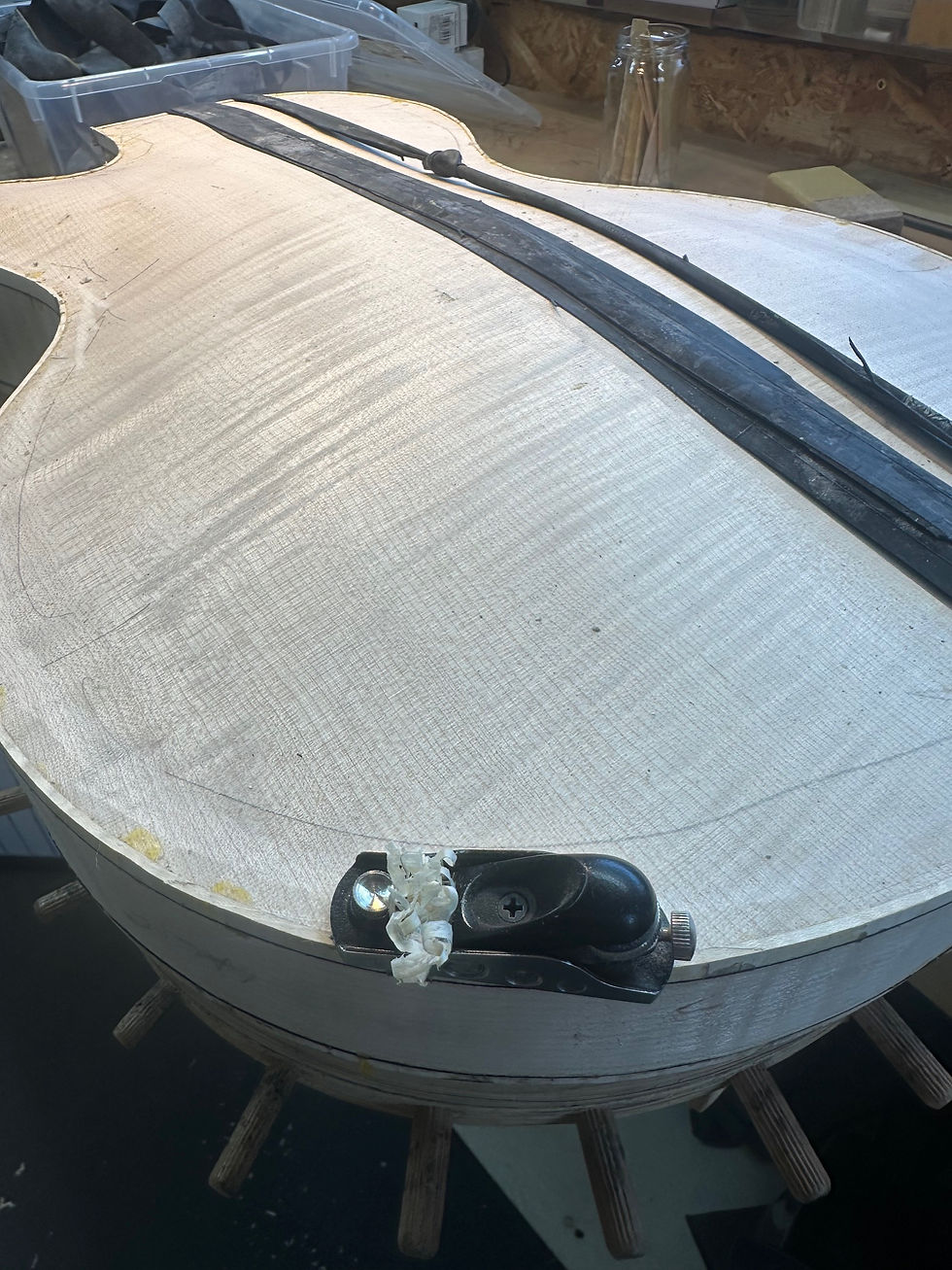
A carved soundboard begins as a substantial piece of tonewood, typically spruce for the top, which is then worked into an arched plate with carefully controlled thickness across its surface. This gives the luthier direct control over where the top remains rigid and where it is allowed to move more freely.
That control is central to projection. If a soundboard is too stiff throughout, it may resist energy and sound tight or constrained. If it is too thin or too flexible in the wrong areas, it may respond quickly at low effort but lose focus when driven harder. Projection relies on a top that moves efficiently while retaining enough structural discipline to keep the note centred.
Carving allows the plates to be graduated rather than left at a uniform thickness. The centre, recurve, flanks and regions around the bridge can all be adjusted according to the specific piece of wood. This is where a carved plate separates itself from a standardised component. No two billets of spruce are identical, and an experienced maker does not treat them as if they are.
Arching, stiffness and the direction of sound

The arch itself plays a considerable part in how a guitar projects. A carved top is not merely decorative. Its geometry affects strength, responsiveness and the way vibrations are distributed across the plate.
An arched plate can support string load more effectively than a flat one, which means it can be made light enough to respond while still retaining the strength needed for clarity and headroom. That combination is one reason carved archtops have a distinctive projection profile. Notes tend to leave the instrument with a quicker, more defined front edge, and the midrange often remains coherent even when the player increases attack.
There is, however, no universal arching formula. A higher arch can produce one sort of response, often with a certain immediacy and compression, while a lower or differently shaped arch may broaden the voice. The result depends on the whole design rather than one measurement in isolation. Good projection comes from the relationship between arch height, arch shape, plate thickness, its deflection, and the elasticity of the wooditself.
Why stiffness is more useful than sheer thinness

Players sometimes assume that a more responsive top must simply be a thinner one. In reality, projection rarely rewards that shortcut. Thinness may increase sensitivity, but unless the plate retains the right stiffness in the right places, the sound can lose authority.
A carved soundboard is most effective when it offers controlled movement. The bridge area must transmit energy cleanly. The surrounding plate must support that transfer without collapsing into a soft, unfocused response. This is why hand-voiced carving matters. It allows the top to be refined for both movement and resistance rather than pushed towards one at the expense of the other.
The role of voicing in how carved soundboards affect projection

Carving is only the beginning. The more important question is how the plate is voiced. Voicing refers to the decisions a luthier makes as the top is brought towards its final state - listening, flexing, testing stiffness, judging weight and adjusting thickness in response.
This process has a direct bearing on projection because the top must be tuned to work with the back, the sides, the bracing and the intended tonal character of the instrument. A carved soundboard that projects beautifully on one guitar body may be entirely wrong on another if the rest of the structure asks different things of it.
On a high-level archtop, projection should not come at the cost of complexity. The finest instruments do not merely throw sound forward. They preserve note shape, harmonic content and dynamic nuance while doing so. That is a more difficult achievement than simple loudness, and it comes from voicing decisions made by hand rather than by specification sheet.
Attack, headroom and note separation

One of the clearest benefits of a well-carved top is the way it handles attack. Projection improves when the guitar produces a clean, immediate start to the note. That initial definition helps the instrument cut through a room, an ensemble or a recording without sounding harsh.
Carved tops also tend to offer more useful headroom when properly executed. As the player digs in, the sound can remain composed rather than flattening out. This matters to serious players because projection is dynamic. It must work at low touch, medium comping force and stronger melodic attack.
Note separation is another part of the equation. Chords with good projection do not become a blur of information. Individual voices remain discernible, especially in the midrange where much of the archtop's musical content lives. That kind of articulation is one of the reasons discerning players often prefer carved construction despite the greater labour and cost involved.
Projection is shaped by wood, not just workmanship

Even the best carving cannot force every top into the same acoustic result. Spruce varies in density, grain spacing, longitudinal stiffness and damping. Two visually similar sets may behave very differently when being carved.
This is why material selection matters so much in boutique archtop building. A maker working at a high level chooses wood not only for appearance but for acoustic potential. Carving then becomes a conversation with that specific set of tonewoods. Projection improves when the top is allowed to become the best version of itself rather than being machined towards a fixed target regardless of its natural character.
Trade-offs every serious player should understand
There is no honest discussion of carved tops without acknowledging compromise. A guitar designed for maximum acoustic projection may not always deliver the same amplified behaviour, feedback tolerance or tonal smoothness a player wants in every context. Likewise, a top voiced for warmth and bloom may project differently from one built for sharper articulation.
Playing style matters as well. A solo chord-melody player may value a broad, complex envelope over a strong directional attack. A performer working acoustically with other instruments may prioritise punch, quick response and midrange focus. Neither preference is more correct. It is simply a question of what sort of projection is needed.
This is where boutique making has a genuine advantage. At Fibonacci Guitars, the point of carved construction is not to satisfy a checklist item. It is to shape an instrument with intent, where projection is part of a wider tonal brief rather than an isolated claim.
What to listen for when assessing a carved-top archtop

If you want to judge projection properly, do not rely only on how the guitar sounds. Ask another player to perform with it while you stand several feet away, then farther back in the room. Listen for whether the note remains centred, whether chords hold together, and whether the sound keeps its identity as dynamics increase.
Pay attention to the balance between bass, middle and treble. Strong projection is usually accompanied by coherence. If one register jumps out while the rest disappears, the instrument may seem impressive at first but less convincing over time. A refined carved top should sound intentional across the range.
Also notice how the guitar responds to variation in touch. Projection worth having is not a one-volume trick. It should reward restraint as much as force, giving the player a broad expressive range without the instrument becoming vague or congested.
Why carved remains the standard for premium archtop

Pressed and laminated tops have their uses, and in some applications they are entirely appropriate. They can offer consistency, durability and a particular amplified behaviour many players value. But when the objective is a truly responsive acoustic voice with depth, precision and authority, carved soundboards still represent the highest standard.
That is because they allow the maker to build around the wood rather than around industrial convenience. Projection, in this context, is not an accident of construction. It is the result of countless small decisions made by skilled hands, each one affecting how the top stores, releases and shapes energy.
For the player who values an archtop as an instrument rather than a commodity, that difference is not theoretical. It is audible in the room, evident when being played and lasting over years of serious use. If you are considering a premium carved archtop, the real question is not whether a carved soundboard affects projection. It is whether you want projection shaped by craft or defined by compromise.


👍